
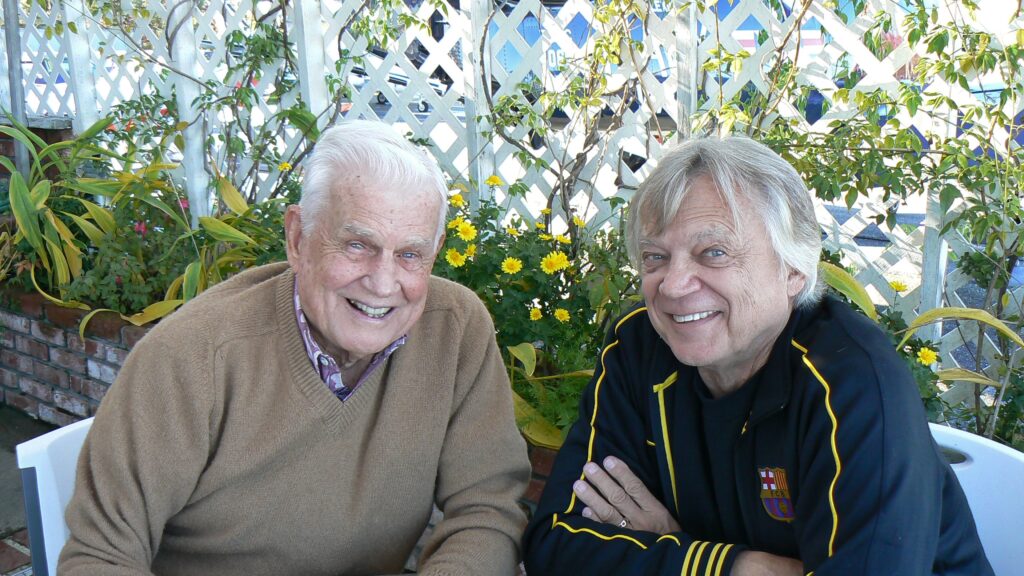
Bud and Co-Author Joe Hamelin
Dogfighting: the ultimate sport
JOE HAMELIN – The Sacramento Bee — Sunday, September 14, 1986
RENO — His picture in good-buddy Chuck Yeager’s best-selling book bears the erroneous caption, “Wingman Bud Anderson.”
“Hell,” Andy sniffed the other day, wearing an amused little smile, “if anybody flew anyone’s wing, he flew mine.”
Yeager was blameless. It was an editor’s error. A quarter-million copies were printed that way. The publisher promised to correct it in later editions, and did.
But when “Yeager” came out in paperback earlier this year, there it was again: “Wingman Bud Anderson.”
“And this time,” Andy said, “they printed a million of ’em.”
So, Clarence Emil Anderson, a retired Air Force bird colonel, likely will be remembered forever as Chuck Yeager’s wingman, flying off to the side and behind, protecting the author’s tail.
Anderson shrugs it away, his ego intact.
He lives quietly and more or less anonymously in Auburn with his wife of 41 years, restoring a 100-year-old house at the edge of the river gorge. Some neighbors know him, some don’t.
There is someone else’s name on the mailbox, and still another name over the doorbell, which doesn’t matter, because Bud Anderson knows who he is, and was.
The fact of the matter is that this soft-spoken, gentle man of 64, who trims his own yard and drives 55 and seldom flies anymore (“I’ve taken on a new personality”), shot 17 German planes out of the air in The Good War.
A triple ace, with change.
His gregarious friend from Grass Valley, who later won fame breaking the sound barrier and selling spark plugs, bagged 12.
BOTH FLEW the P-51 Mustang, the aircraft that, more than 40 years later, is still the most popular steed at the Reno Air Races.
The annual closed-course affair, which concludes here today, draws six-figure crowds. Romancing WWII has grown popular. Yet Anderson has resisted coming here until now, though the planes are familiar.
When you’ve bounced 16 German fighters, all of them Messerschmitt 109s and Focke-Wulf 190s, and helped down a twin-engined Heinkel (officially, he is credited with 16¼ victories, two probables and one ground kill), flying in circles seems rather tame stuff.
Still, Anderson is uniquely qualified to lecture on the sleek little fighter, having flown 116 combat missions in P-51s, spending 480 hours over occupied Europe, engaging the enemy perhaps 40 times.
It was, he will tell you, the ultimate sport.
Machine guns and cannon at 100 yards, sometimes less.
“I won’t deny I enjoyed combat,” he said. “There were guys who were just flat scared the whole time they were there, but after five or six missions, honestly, I wasn’t afraid. He lived from day to day. No fuzz on it. ‘If I get hit, I’m dead, so let’s go.’
It wasn’t like the grunts in the trenches. You didn’t see gory death and maimed buddies. To any degree. You were fighting against a machine, not a man. It was you and him, one on one. The ultimate challenge. Pretty exciting.”
So exciting that when his first tour was done, he signed up for another.
HE IS A TRIM 5-foot-9. His hair has gone silver but has made no retreat. The face is tanned and deeply lined, the face of a man who spends his spare time in trout streams.
The eyes are the 20-10 eyes of a hunter, which is just what he was.
“The trick was to see the German before the German saw you. It was also helpful to have the superior airplane.”
The Mustang, Anderson said, “had to be the best all-around fighter out of World War II. It was maneuverable. It was good at low and high altitudes. And it had great range.”
It was range that mattered.
The Mustang gave Allied bombers fighter cover all the way to German targets and back. It made life hell on the Messerschmitt pilots.
“Ultimately, it changed the course of the war.”
“Maybe a Spitfire could outrun it with equal pilots,” Anderson said. “But it couldn’t outrun you over Berlin, ’cause it’d never get there.”
He had three Mustangs: a P-51B, which another pilot crashed on Andy’s day off; a second “B” that eventually was refitted with a Spitfire-type Malcolm canopy; and, for his second tour, a P-51D, the bubble-top version, with six guns instead of four.
All were called “Old Crow,” after a booze that he fancied.
“My Baptist friends ask me,” he said, “and I tell ’em it was named after the smartest bird in the air.”
ON NONE OF the 116 occasions did his Mustangs fail him mechanically. He never aborted a mission.
Only once did an enemy bullet ever find him. A small arms round, fired from the ground, made a harmless, coin-sized hole in a wing. He was lucky, he is quick to admit.
He says he was lucky like Arnold Palmer, the golfer, who used to say, “The more I practice, the luckier I get.”
You left nothing to chance if you were a hunter and wanted to last through two tours. You kept your plane spotless. You stayed sober the night before missions.
And you always drew your gun first, if you could.
There were no points for sportsmanship.
Anderson drew the line at machine-gunning parachutes. But there were those on both sides who did. He knew two: a transfer from the Pacific theater who’d seen the Japanese do it, and a fellow who’d seen a German torch a B-17, then methodically strafe the ones who got out.
No, there wasn’t much chivalry in it.
You’d come up from behind, and if you were good or lucky, the other fellow wouldn’t see you at all, and you’d thumb your gun button and blow him away, then shoot film of the wreckage.
HE GREW UP between Newcastle and Penryn, raised by parents who read a chapter from the Bible each night. He played basketball at Placer High School, Class of ’39. He studied two years at Sacramento Junior College. No one ever taught him how to deal with the moral dilemma of blowing people away.
When he went off to war on his 20th birthday, Jan. 13, 1942, his mother gave him a Bible. He didn’t wear it out, exactly, but he picked it up before his first combat, and stumbled across something that said it was cool to smite God’s enemies. After that, he never thought much about it.
God, he reasoned, never had an enemy any worse than Hitler.
Occasionally (twice in Anderson’s experience), the business of war was more sporting. There were dogfights, man against man, the planes evenly matched, swirling across vast expanses of sky.
These he remembers, as vivid as Ektachrome.
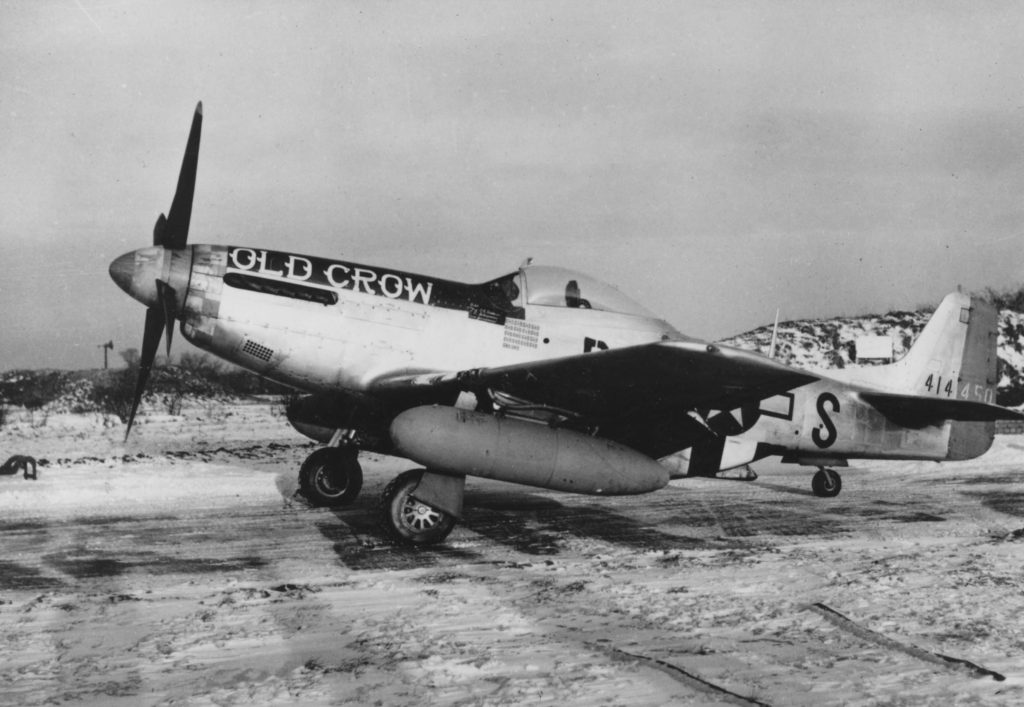
Clarence Emil Anderson flew this P-51 Mustang during World War II.
The day was brilliant, cloudless. They were escorting bombers, flying very high. From above and behind, four Messerschmitts jumped his flight well above 30,000 feet. Anderson shot one down right away, then dove after another. The angle was wrong, so he broke away, climbing straight up. But the German came right up the chute after him “until I’m looking down at that big 109 nose, with a cannon sticking up through it . . .
“Fortunately, he stalled first, falling away, just before I did.”
AGAIN, ANDERSON dove at the German, again the angle was wrong; again he broke away climbing, and again the German pursued him. Only this time, “I pulled off the throttle, slipped in a little flaps,” and when the German shot past, “I hit him going straight up, got hits right in the cockpit,” Andy said.
The plane fell over and plunged 30,000 feet into the checkerboard countryside, “straight in, no turn, no spin, no nothin’.”
The Mustang had some disadvantages. It had an 85-gallon fuel tank right in back of the pilot. When full, the weight so far aft made the aircraft unstable.
On the shorter hops, you would burn the fuel out of this fuselage tank first, so it would be empty before engaging in combat. The fuel stored inside each wing would get you home.
But on the longer flights, you’d need lots of fuel, and so first you’d burn the drop tanks dry.
On one run into Poland, the 109s appeared suddenly, line abreast, coming at the bombers head-on, trailing white contrails . . . and the Mustangs had to engage them with their fuselage tanks still full.
Andy singled out a German who’d circled for a second pass at the bombers. The two began turning, tighter and tighter, trying to get on each other’s tail.
And then the controls reversed on him, which is what sometimes happened with a full fuselage tank. It sometimes got people killed.
HE JAMMED the stick forward to keep turning, which is how you reverse a reversal, which is a hell of a thing to have to puzzle out when someone is shooting at you.
“Remember it the rest of my life,” he said. “Very unusual way to fly.”
What he remembers, too, was suddenly realizing he and the German were turning their circles right in front of the bomber formation, which was bearing down on them.
The first break out of the circle would be at a grim disadvantage.
Andy was gaining. The German broke away, dove, turned hard, and came up at Andy head-on. His cannon was winking, but Anderson hit him first.
The other plane flew apart and went down.
On the way home, he and the three on his wing knocked down the Heinkel.
It was a long time ago now. He came home, married Auburn’s Ellie Cosby and fathered a son and a daughter. He was a test pilot. He commanded an F-86 squadron in Korea. He flew 25 missions in the Vietnam War aboard F-105s.
He has two Legion of Merits, five Distinguished Flying Crosses, the Bronze Star, 16 Air Medals and the French Croix de Guerre.
It’s been quite a life, he allowed, and the best of it was the year spent with Yeager clearing the skies over Germany.
There is a Ray Wadday lithograph of Anderson and Yeager in their P-51Ds, hunting together. Double Trouble, the artist called it. One plane is flying a little ahead of the other.
Anderson displayed a copy, winked and said, “Notice who’s flying whose wing?”